
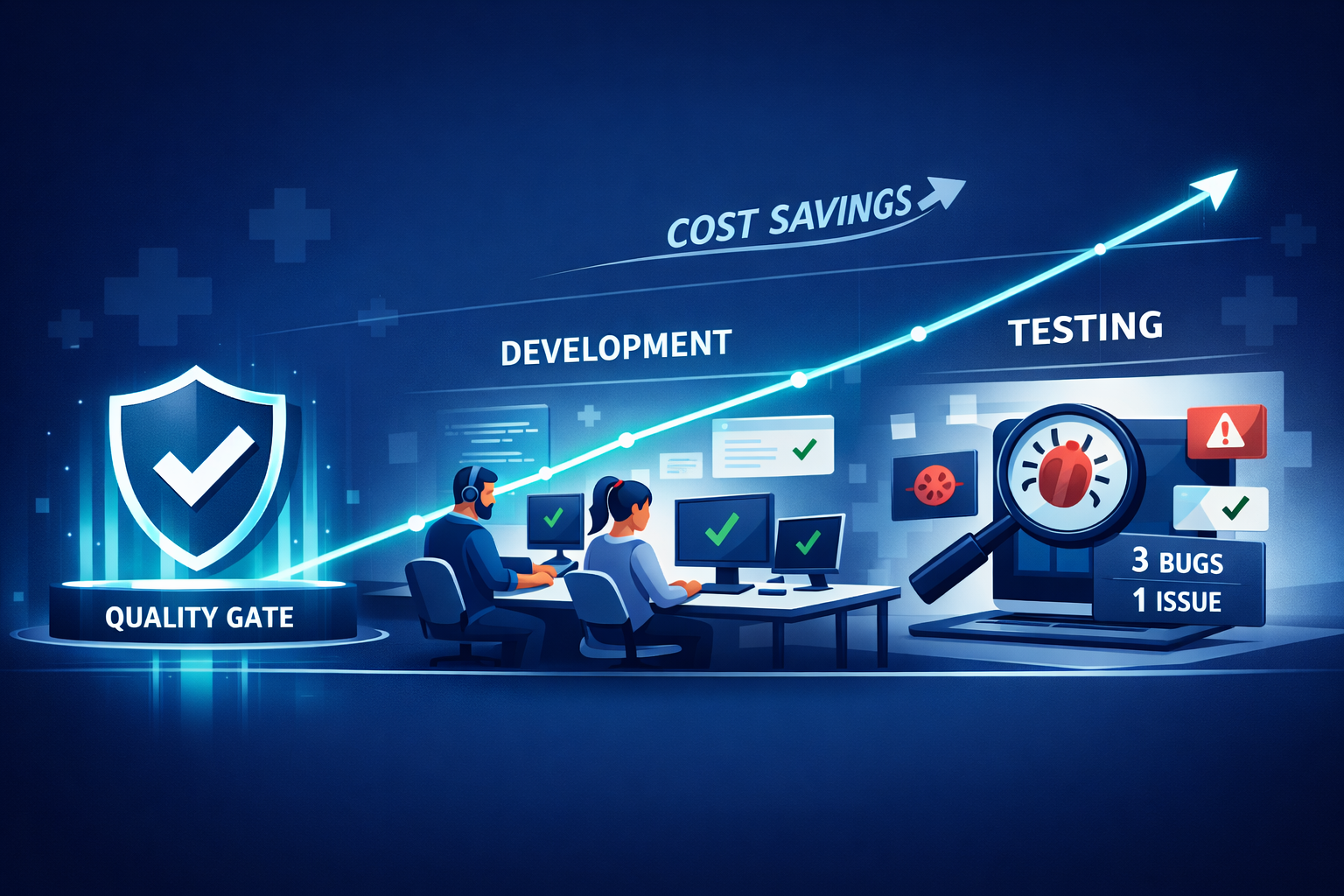
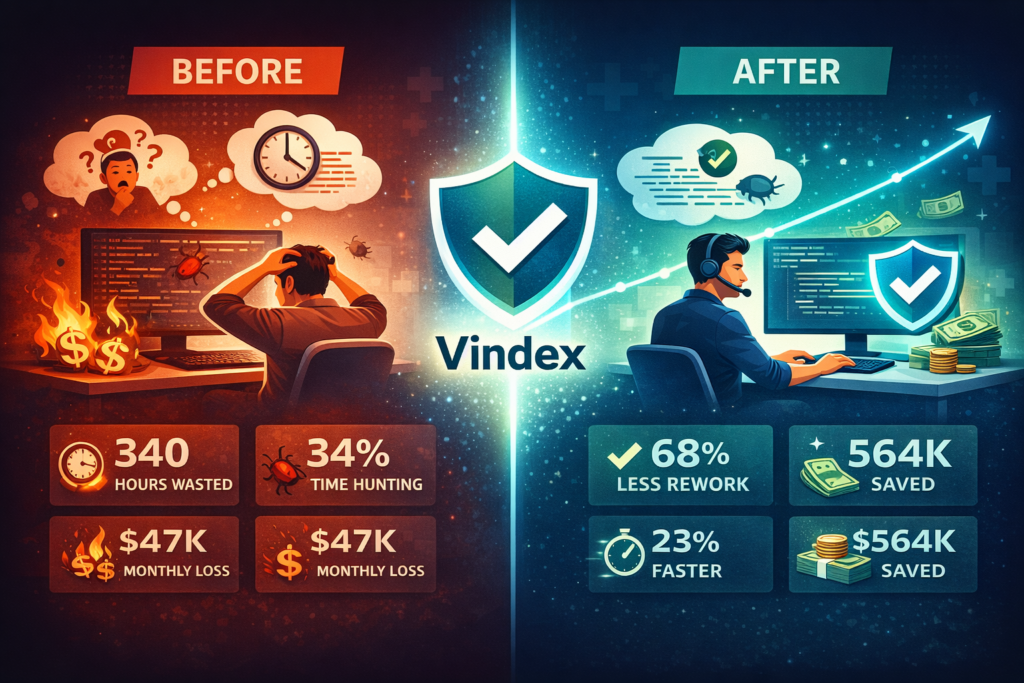
A 280-employee healthcare technology company was burning 340+ engineering hours monthly on requirements-related rework—fixing bugs, clarifying ambiguous tickets, and chasing missing context. By implementing Vindex, Auxiliary Digital’s AI-powered requirements quality gate, they reduced rework by 68% and saved $47K monthly while accelerating feature delivery by 23%. Most importantly: they caught HIPAA compliance gaps before code was written, not during expensive UAT cycles.
The Business Challenge
MedConnect (name changed), a patient scheduling and communication platform serving 450+ healthcare providers, faced a productivity crisis that threatened their competitive position. Their engineering team was technically excellent, but constantly firefighting preventable issues.
The symptoms were clear:
- Engineering sprints started with 85% story point commitment but consistently delivered only 52%
- Post-deployment bugs averaged 47 per quarter, with 73% traced to “requirements weren’t clear”
- HIPAA compliance reviews found issues in 1 out of every 3 features during UAT—requiring expensive emergency fixes
- Developer surveys showed 34% of time spent “hunting for context” rather than coding
The financial toll:
- An estimated 340 hours monthly are wasted on requirements-related rework
- $47,000 in monthly productivity loss (at $138/hour blended rate)
- 6-week average feature delivery time (2 weeks longer than competitors)
- Compliance remediation costs averaging $85K per quarter
The strategic risk was even greater: In healthcare technology, ambiguous requirements don’t just slow velocity—they create patient safety risks and regulatory exposure. Every unclear specification about PHI handling or consent workflows could result in HIPAA violations, with penalties starting at $100 per violation.
The VP of Engineering knew they needed a fundamental shift: catch quality problems before developers touch the keyboard, not after deployment.
The Requirements Quality Gate
Rather than add more testing or code review layers—which would further slow delivery—MedConnect needed to shift quality upstream. The insight: most bugs and rework stem from requirements that were never ready for development in the first place.
The shift-left strategy had three components:
1. Automated Quality Certification
Vindex analyzes every user story against the INVEST framework (Independent, Negotiable, Valuable, Estimable, Small, Testable) and adds a quality score as a comment on the ticket. Teams can see instantly whether a story meets their 95% confidence threshold, eliminating the gray area that caused endless debates between Product and Engineering about what “ready” means.
2. Context Verification Engine
The system doesn’t just check if links exist—it verifies that referenced design files, API documentation, and compliance guidelines are current and actually relate to the story. This eliminated the “oh, that Figma file is outdated” discoveries that would happen three days into development.
3. Compliance Guardrails
For a healthcare platform, every feature touching patient data must reference specific HIPAA controls and security requirements. Vindex flags stories missing these critical links before they waste developer time—catching compliance gaps in requirements definition, not during expensive UAT.
Implementation timeline: 3 weeks from pilot to full rollout across 4 product teams.
Results: From Firefighting to Flow
MedConnect deployed Vindex in January and measured impact monthly. The results validated the shift-left approach.
Financial Impact
Productivity Recovery:
- Development rework hours: 340/month → 108/month (-68%)
- Monthly productivity savings: $47,000 (based on eliminated rework)
- Annual impact: $564,000 in recovered engineering capacity
- Payback period: 14 days (implementation cost: $32K)
Compliance Cost Reduction:
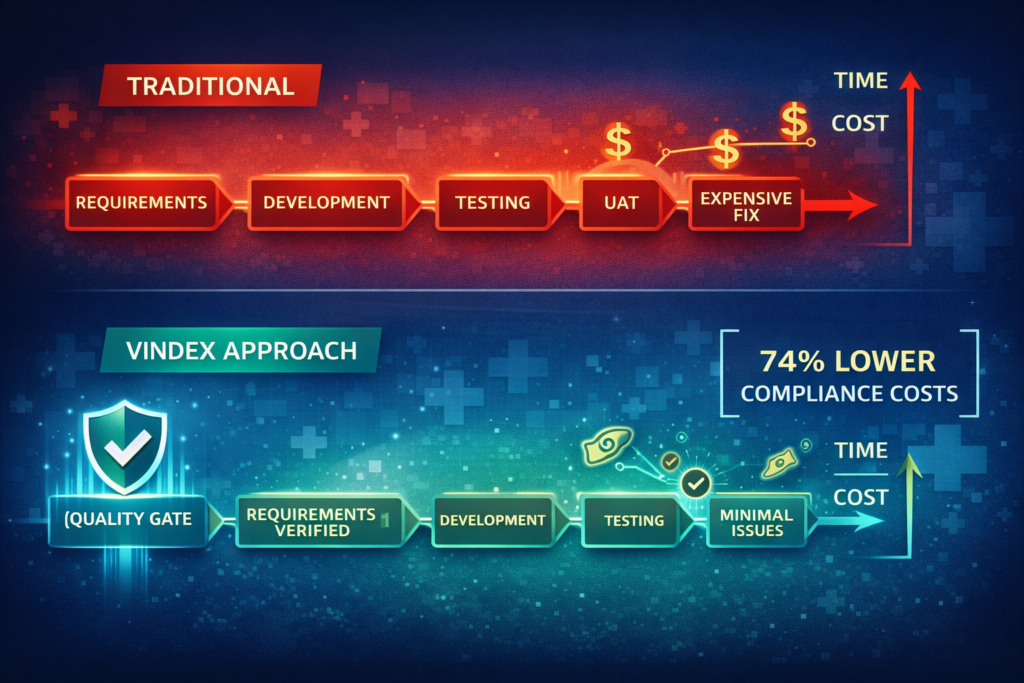
- HIPAA-related rework: $85K/quarter → $22K/quarter (-74%)
- UAT compliance findings: 47/quarter → 9/quarter (-81%)
- Emergency compliance fixes: 12/quarter → 2/quarter (-83%)
Velocity & Quality Improvements
Delivery Speed:
- Sprint commitment delivery: 52% → 89% (+71% improvement)
- Feature delivery time: 6.2 weeks → 4.8 weeks (-23%)
- Stories blocked on clarification: 34/sprint → 4/sprint (-88%)
Quality Metrics:
- Post-deployment defects: 47/quarter → 15/quarter (-68%)
- Requirements-related bugs: 34/quarter → 6/quarter (-82%)
- “Could not reproduce” bug reports: 23% → 4% (-83%)
Team & Process Gains
Developer Experience:
- Time spent “context hunting”: 34% → 11% (-68%)
- Sprint satisfaction scores: 62% → 87% (+40%)
- On-call incidents from ambiguous requirements: 8/month → 1/month (-88%)
Product Team Impact:
- Requirements clarification interrupts: 45/week → 12/week (-73%)
- Stories returned from dev for clarification: 18/sprint → 3/sprint (-83%)
- Time spent on requirement definition: +12% (but higher quality up front)
Strategic Advantages
Regulatory Confidence:
The compliance verification layer meant security reviews now happen at requirements phase, not after code is written. This transformed their audit posture—demonstrating “security by design” rather than retrofitting compliance.
Predictability for Leadership:
With consistent 89% sprint commitment delivery, the executive team could finally commit to customer roadmap dates with confidence. Sales could promise features knowing Engineering would deliver.
Foundation for Scale:
The structured requirements process enabled MedConnect to onboard 3 new product managers in Q2 without degrading quality—the system enforced standards regardless of experience level.
Key Takeaways for Healthcare Technology Leaders
1. Shift-Left Pays Immediate Dividends
MedConnect saw positive ROI in 14 days. Every hour invested in better requirements saved 3+ hours of development rework. In healthcare, where compliance stakes are high, catching issues in requirements is exponentially cheaper than finding them post-deployment.
2. Developer Time is Your Scarcest Resource
At $138/hour blended rate, 340 monthly hours wasted on unclear requirements represented $564K annually in opportunity cost—features not shipped, technical debt accumulating, experienced engineers doing work that could be prevented.
3. Quality Gates Don’t Slow Teams Down
Initial concern: “Won’t this add bureaucracy?” Reality: removing ambiguity accelerates delivery. Vindex provides instant visibility into quality gaps without changing existing workflows—teams can see scores and decide how to proceed. MedConnect’s feature delivery improved 23% because developers received clearer requirements and spent less time seeking clarification.
4. Compliance Earlier = Compliance Cheaper
HIPAA violations found during UAT cost $85K per quarter to remediate. The same issues caught at requirements phase cost effectively zero—just better specification before work begins. The compliance team now reviews tickets, not deployed code.
When this approach makes sense:
- You’re in a regulated industry (healthcare, finance, legal) where ambiguity creates compliance risk
- Your teams report spending >20% of time on context-switching and clarification
- Post-deployment bugs frequently trace back to “requirements weren’t clear”
- You’re scaling product teams and need to maintain quality standards
Red flags to watch for:
- Teams that won’t enforce quality standards even with objective scoring
- Organizations that haven’t adopted Agile/story-based planning yet
- Lack of executive sponsorship for shift-left quality approach
The Bottom Line
MedConnect’s VP of Engineering summarized it well: “We thought we had a quality problem. We actually had a requirements problem. Vindex gave us the discipline to fix issues before our best engineers waste time on them.”
By shifting quality verification from post-code to pre-code, they recovered the equivalent of 1.5 full-time senior engineers annually while simultaneously improving compliance posture and delivery predictability.
For healthcare technology companies, where every unclear requirement carries both productivity cost and regulatory risk, the shift-left approach isn’t optional—it’s strategic necessity.
Ready to eliminate requirements-related rework in your engineering organization?
Schedule a 30-minute consultation to explore how Vindex could apply to your specific development challenges and compliance requirements.