

Vindex — Comment ça fonctionne
Améliorez la qualité des exigences dans Jira sans changer la façon dont vos équipes travaillent.
Vindex évalue la clarté et l'exhaustivité des exigences, puis fournit des commentaires précis et exploitables directement sur le ticket afin que les équipes réduisent les retouches et évitent les surprises de dernière minute.
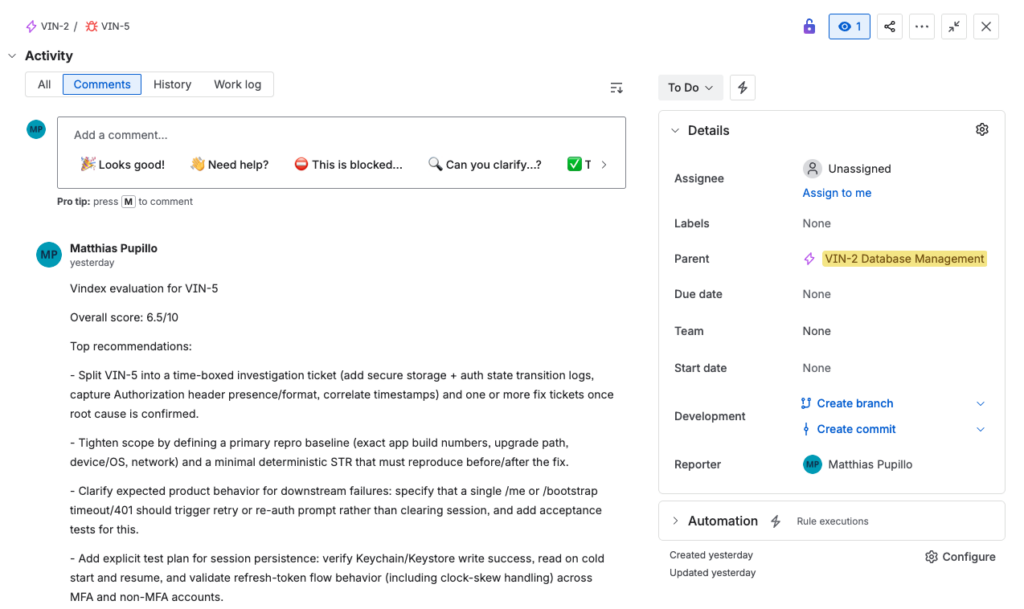
Connectez Jira
Qualité de courant de référence
Note chaque ticket
Explique ce qui manque
Suggérer des améliorations concrètes
Suivre les tendances au fil du temps
Se connecter à Jira
L'équipe auxiliaire Digital offre un support personnalisé gratuit pour une durée limitée.
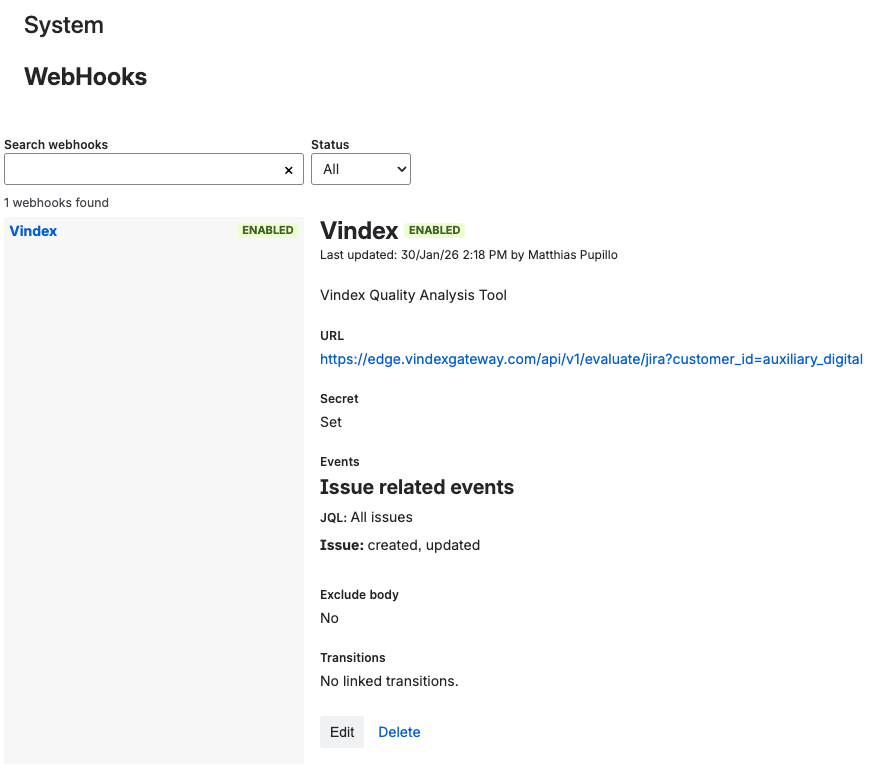
Nous avons configuré Vindex pour lire les champs Jira que vos équipes utilisent réellement — résumé, description, critères d'acceptation, champs personnalisés, étiquettes, composants et problèmes liés.
- Fonctionne avec vos flux de travail actuels
- Prend en charge le déploiement progressif (un projet → expansion)
- Autorisations alignées sur vos exigences et votre posture de sécurité
Qualité de courant de référence
Établir une ligne de base
(ainsi, les résultats sont démontrables)
Avant de changer quoi que ce soit, Vindex établit une référence de base afin que vous puissiez répondre :
- À quel point nos billets sont-ils clairs aujourd'hui ?
- Où se regroupe l'ambiguïté ?
- Quels équipes/projets ont le plus besoin de soutien ?
Cela devient l'image du « avant » en laquelle votre leadership aura confiance.
Notez chaque ticket en utilisant INVEST
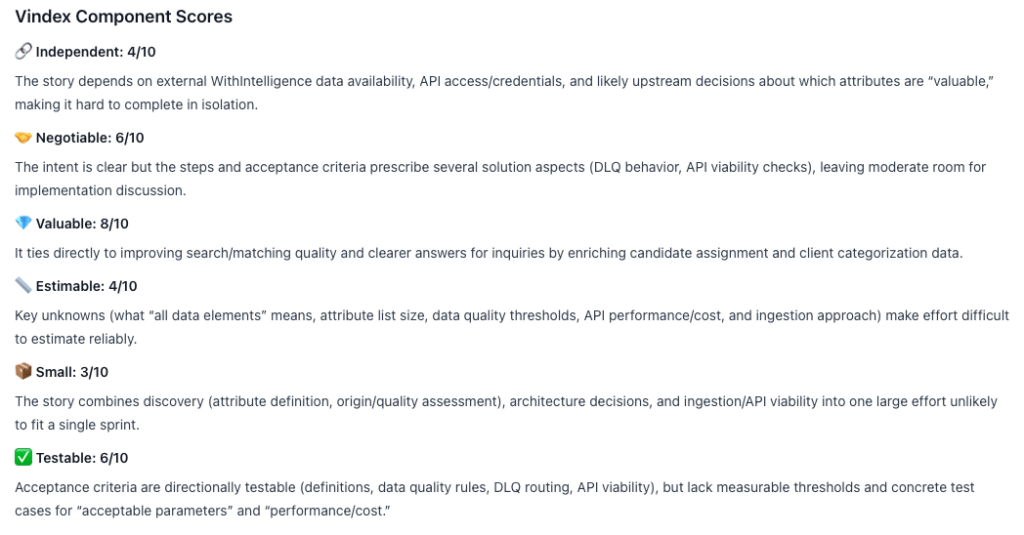
Vindex évalue la nécessité telle qu'elle est formulée en utilisant une grille cohérente :
- Indépendant — des dépendances ou obstacles cachés sont identifiés
- Négociable — évite d'être un plan de mise en œuvre déguisé
- Précieux — résultat clair pour l'utilisateur/l'entreprise
- Estimable — une clarté suffisante pour juger avec confiance
- Petit — appropriément défini pour les cycles de livraison
- Testable — critères d'acceptation vérifiables et conditions de réussite
En plus de la notation, Vindex met en évidence les lacunes pratiques que les équipes manquent systématiquement :
- limites flous du périmètre (« ce qui est inclus / ce qui est exclu »)
- cas manquants et états d'échec
- termes et hypothèses ambigus
- points de contact d'intégration et considérations relatives aux données
- attentes non-fonctionnelles (performance, sécurité, audit, accessibilité) lorsque cela est pertinent
Explique ce qui manque et propose des améliorations concrètes
Fournir des commentaires exploitables à l'intérieur du ticket
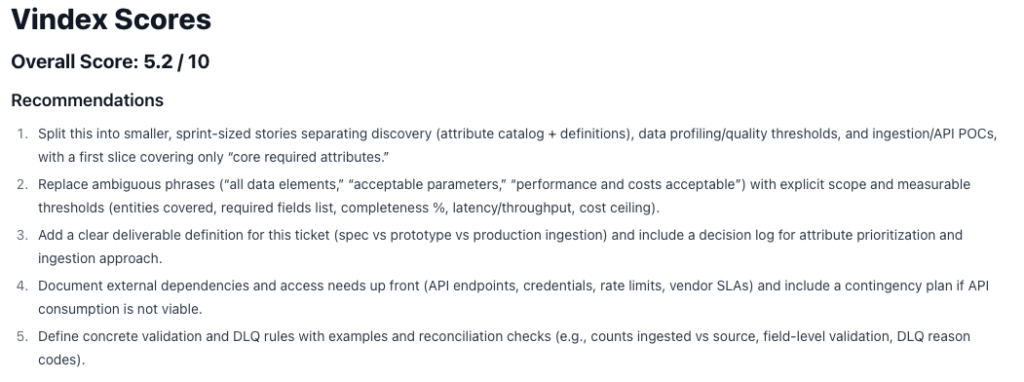
Vindex ne se contente pas de noter — il explique ce qu'il faut faire ensuite. Chaque ticket reçoit :
- UN score + répartition
- Une courte Ce qui manque liste
- Suggéré améliorations des critères d'acceptation
- Invite à clarifier dépendances / intégrations
- Optionnel suggestions de réécriture lorsque la description est trop vague ou trop prescriptive
Cela réduit les aller-retour lors du grooming et empêche que « clarifier plus tard » ne devienne une reprise.
Ce que vous obtenez dans un pilote
Résultat : une « avant/après » pratique et défendable qui montre si Vindex améliore la qualité des exigences et réduit le taux de rotation en aval.
Livrables typiques du pilote
- Rapport de qualité de référence
- Profil de notation ajusté aligné sur vos modèles d'écriture et votre domaine
- Plan de déploiement pour les équipes (modèles, exemples, notes de coaching)
- Compte rendu des résultats que vous pouvez partager avec la direction technique/produit
Temps jusqu'à la valeur : Un signal significatif apparaît souvent au cours des premiers cycles de toilettage.




Vindex remplace-t-il le jugement de Produit, BA ou Ingénierie ?
Non. Cela rend la qualité visible et cohérente—pour que les gens consacrent du temps à de véritables décisions, et non à une ambiguïté évitable.
Cela ralentira-t-il les équipes ?
Cela accélère généralement les équipes en réduisant les relances, les retouches et les clarifications en fin de processus—en particulier lors de la préparation et de la planification des tests.
Pouvons-nous personnaliser ce à quoi ressemble « bien » ?
Oui. Nous pouvons ajuster le scoring et l'orientation pour refléter vos modèles, votre terminologie, vos contraintes de livraison et ce que vos équipes considèrent comme « suffisamment clair pour construire ».
Qu'en est-il des faux positifs ou des retours trop génériques ?
C'est pourquoi les pilotes incluent le réglage et (optionnellement) des sources de contexte. La pertinence s'améliore à mesure que Vindex s'aligne sur votre vocabulaire et vos exemples concrets.
Prêt à le voir sur vos tickets Jira ?
Vindex est conçu par Auxiliary Digital pour les équipes qui souhaitent une amélioration mesurable de la qualité des exigences—sans augmenter la charge processuelle.