Most AI pilots fail for the same reason: they’re built to demonstrate capability, not to survive an operating environment. The model works in the demo. The stakeholders nod. And then the project quietly dies, because nothing about it was designed for the messy, integrated, accountable world where production software lives.
The pattern is so common it has a shape. Here are the five failure modes we see most — and what it takes to avoid them.
Failure mode 1: The AI never learned your business
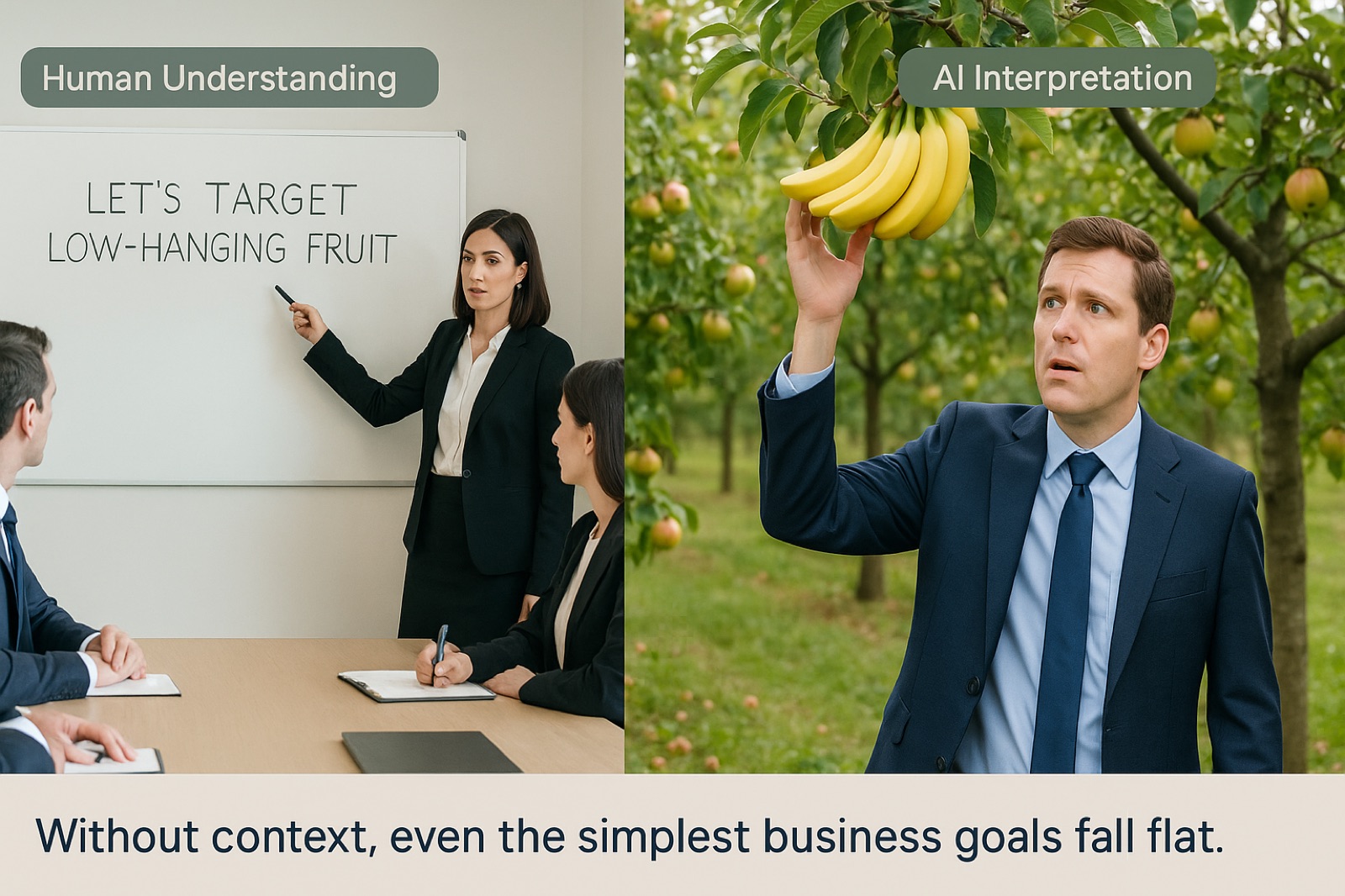
AI systems don’t inherit institutional knowledge. They interpret text, predict patterns, and follow training — but they don’t know your customer journey, your supply-chain quirks, or your compliance boundaries unless someone deliberately gives them that context.
We’ve written about what happens when they don’t: one logistics operation’s AI labeled inventory accurately by every benchmark, but didn’t understand operational nuance — supplies already in transit were re-ordered, costing $10M over 18 months. The model wasn’t wrong. It was uninformed.
A pilot can hide this failure mode for months, because pilots run on curated examples. Production runs on edge cases.
Failure mode 2: It lives outside the workflow
A pilot that requires people to open a separate tool, copy results back, or “check what the AI said” is already dead — the funeral just hasn’t been scheduled. Adoption is not a training problem; it’s an architecture problem.
The systems that survive are invisible. When we built translation automation for a healthcare SaaS, the single most important architectural decision wasn’t the AI — it was that developers never touched it. They committed code exactly as before; translations happened in the background. Zero adoption friction, because there was nothing to adopt.
Failure mode 3: Nobody engineered it for production
A demo needs a model and a prompt. A production system needs monitoring, fallback behavior, cost controls, retraining loops, security review, and an answer to “what happens when it’s wrong?” That gap is engineering work — usually more engineering than the pilot itself — and most pilots budget zero for it.
This is where “AI pilot” and “production software” reveal themselves as different disciplines. The teams that cross the gap treat the pilot as the first iteration of a production system, not a separate artifact to be rebuilt later.
Failure mode 4: The data wasn’t ready — and everyone knew it
Ask the team running a stalled pilot about their data and you’ll usually get an honest grimace. Inconsistent taxonomies, undocumented business rules, systems that disagree about the same fact — the pilot worked because someone hand-fed it clean examples, and production would mean confronting the mess.
The fix isn’t a two-year data program before anyone touches AI. It’s scoping the pilot around a slice of data you can actually stand behind, and treating the gaps you find as part of the pilot’s output — a map of what production will require.
Failure mode 5: No owner, no metric, no decision
Many pilots aren’t failed experiments — they’re experiments nobody designed to conclude. There’s no baseline measurement, no business metric on the wall, and no named owner whose job includes saying “ship it” or “kill it.”
Compare that with how a conclusive engagement runs: baseline captured first, a business metric agreed up front, and a decision date. Our requirements-quality deployment at a healthcare platform measured rework hours monthly against a pre-launch baseline — which is why leadership could see a 14-day payback instead of debating a demo.
What production-ready actually requires
If you’re evaluating whether your pilot can graduate, the checklist is short but unforgiving:
- Context: the system knows your terminology, rules, and edge cases — explicitly, not by luck
- Integration: it operates inside the tools where work already happens
- Operations: monitoring, fallbacks, cost visibility, and a plan for wrong answers
- Data: the production data slice is defined, and its gaps are known
- Ownership: a named owner, a business metric, a baseline, and a decision date
How we approach it
At Auxiliary Digital, we don’t run pilots that are designed to be thrown away. Our teams work as one unit across Gather, Build, and Validate — the business context gets captured before code, validation runs alongside the build, and the “pilot” is simply the first working slice of the production system. It’s the same shift-left discipline that eliminates defects in requirements, applied to AI.
If you have a pilot that’s stuck — or you want to start one that won’t get stuck — schedule a consultation. Thirty minutes is usually enough to tell which failure mode you’re closest to, and what it would take to close the gap.